

 Apple Podcasts
 Spotify
 NXT
NXT
 ROH
ROH
 MLW
MLW NWA
NWA GCW
GCW HOG
HOG NJPW
NJPW AAA
AAA NOAH
NOAH CMLL
CMLL UFC
UFC Professional Fighters League
 Real American Freestyle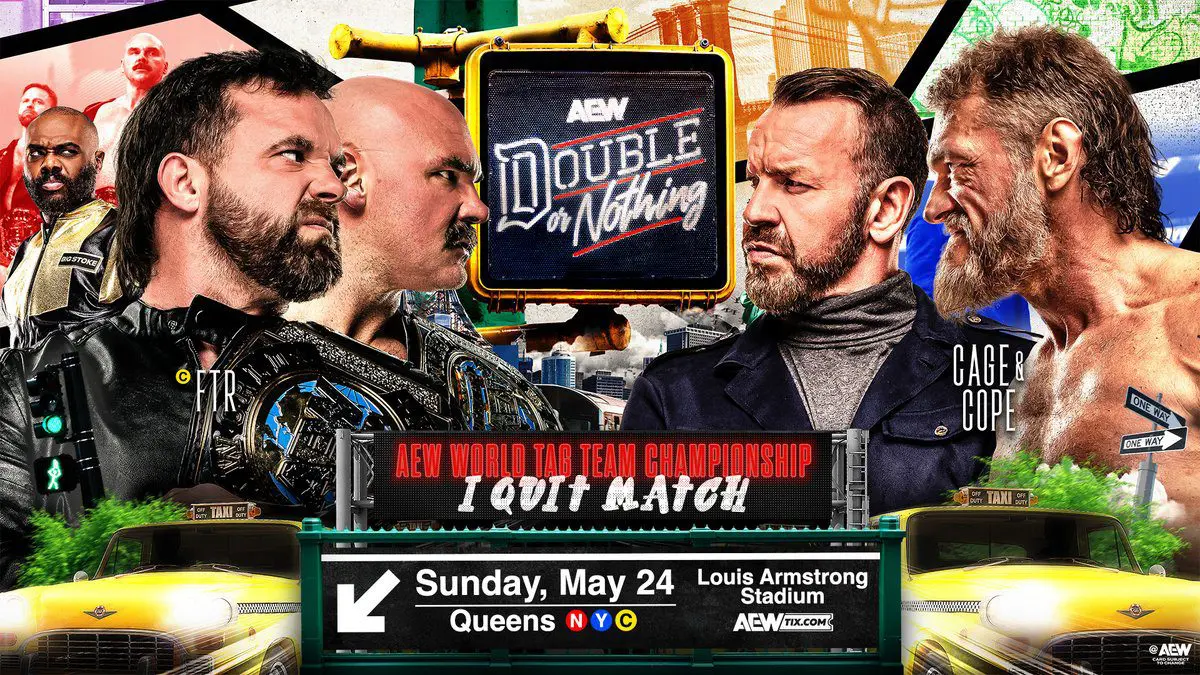

I have been a fan of FTR since they were The Revival, and the people who read me know it, so I am not going to pretend to be neutral about Sunday night. I once spent a long time alone in a car park in Texas after a tag team match they wrestled, and I have not been the same kind of fan since. That is the kind of FTR fan I am. What I want to write here is not a love letter, though, because the match at Double or Nothing is more interesting than fandom can adequately describe. It is interesting on the level of the four men in the ring, on the level of the two teams, on the level of the audience watching, and on the level of a division, a company, an industry, and a form. The stipulation underneath it is doing something professional wrestling almost never does, which is ask a question with a real answer.
Dax Harwood and Cash Wheeler have spent a decade making the same argument, and on Sunday night in Queens they will make it again, against the longest-running tag team story in mainstream professional wrestling.
The argument is this: that the tag team, as a unit of professional wrestling, is a serious thing. That it deserves to be treated with the gravity once afforded to it by Arn Anderson and Tully Blanchard, by the Midnight Express, by the Brain Busters and the Rock ‘n’ Roll Express. That two men who tag in and tag out, who cut the ring, who refuse to flip and refuse to break character and refuse to wrestle as anything other than a team, can carry a pay-per-view. FTR have made this argument from every promotion that would have them. They have made it in WWE as The Revival and they have made it in ROH and they have made it in New Japan and they have made it across six years now in AEW, and they have made it well enough and consistently enough that the argument is no longer really an argument. It is the most decorated tag team body of work of the modern era. On Sunday night, they defend it.
Across the ring stand Adam Copeland and Christian Cage, who have been a tag team for longer than some of the wrestlers on the card have been alive. They formed in the late nineties as a pair of Toronto kids who had grown up together. They became one of the defining acts of the Attitude Era. They held the WWF tag titles seven times. They main-evented pay-per-views. They fell out, reconciled, retired, returned, retired again, returned again, and now, in the year 2026, with both men deep into the back half of their careers, they find themselves standing across the ring from a tag team that wants to end them. The story of Cope and Cage is, in the genuine sense of the word, historic. It is the longest continuous tag team narrative in mainstream professional wrestling. It is also, by stipulation, set to end on Sunday night if FTR can make it end.
Wrestling almost never lets a story finish. Feuds blur into other feuds, teams drift apart through the quiet attrition of forgotten bookings, careers end with a whimper or no ending at all. The trilogy at 1-1 is a structure professional wrestling reaches for and almost never executes cleanly, because executing it cleanly requires the discipline to actually let one team lose. Sunday is the stipulated third act. The retirement clause is the cost of getting it. AEW has, in effect, paid the price required to give this story a real ending, and the price was Cope and Cage agreeing in advance to disappear as a unit if Dax and Cash could do to them on Sunday what they have already done to them once before.
The stage is Louis Armstrong Stadium. It is the first Double or Nothing held inside the five boroughs of New York City. It is the biggest stage the company has ever built for this pay-per-view. And the match they have chosen to place at the centre of it, the one carrying the weight of finality and history and craft and stakes, is the one in which FTR have been asked, again, to make their argument.
The argument, like the partnership across the ring from it, has four people inside it.
Dax Harwood is the most outspoken wrestler of his generation about what tag team wrestling is for. He writes about it. He talks about it on his podcast at length and with the unembarrassed seriousness of a man who has decided this is his life’s work. He cites Arn Anderson the way a young novelist cites Cheever. He has, more than once, articulated a theory of tag wrestling, that the team is the unit of meaning, that the psychology lives in the cut-off and the hot tag rather than in the dive, that a good tag match is closer to a long con than a highlight reel, and he has spent his entire career trying to prove the theory by wrestling it. I have spent years arguing alongside that theory in print, because I think it is right, and because Dax is one of the very few active wrestlers who has built a body of work that proves it on tape. Sunday is, in some sense, the largest single test of that theory he has ever been handed. He is across the ring from the team that, more than any other in the modern era, can claim to have proven a different theory: that two charismatic singles wrestlers can also be one of the greatest tag teams of all time. Dax has been waiting a long time to argue with that.
Cash Wheeler does his arguing in the ring. He is the quieter half of FTR by some distance, the one less inclined to give the long interview or write the column, and he is also the half of FTR whose in-ring work has, over the last three years, quietly become some of the best tag wrestling on the planet. He is the engine. He is the man who eats the heat, who sells the leg for eight minutes, who makes the hot tag mean something by spending the time before it being broken. In an I Quit match, with no count-outs and no disqualifications and a stipulation that ends only when one man breaks, Cash is the kind of wrestler the format was designed for. He does not break easily. He is not going to be the one who says it.
Christian Cage is doing the most interesting character work of his career at the age of fifty-two. The version of Christian who has wrestled in AEW since 2021 is not the affable face of the Attitude Era and is not really the heel version anyone remembered from before. It is something newer and stranger, a sneering, articulate, openly contemptuous heel who treats every promo like a closing argument and has, across five years, become genuinely one of the best talkers in the company. He is the brain of Cope and Cage. He is also the half of the partnership most likely, in the existing storyline logic of the feud, to find a way to win that does not require him to actually quit. Whether he will let his partner quit on his behalf is the more interesting question, and it is a question that goes to the heart of what a partnership is and what one half of a partnership owes the other.
Adam Copeland is the reason the match has the stipulation it has. He made the challenge himself, on the April 25th Dynamite, and he made it in the form of an offer FTR could not credibly refuse: a rematch on the condition that he and Christian would, if they lost, end as a team. It was a strange and significant thing for a wrestler to do. Copeland has a Hall of Fame ring. He has nothing left to prove individually. What he has chosen to put at risk on Sunday is not his career and not his legacy as a singles wrestler but the thirty-year partnership with the friend he started wrestling with as a teenager. That is the offer he made. Sunday is the night it is paid out.
What gives the offer its weight is the fact that the two teams it brings into collision are not making the same argument about what a tag team is.
FTR are the most credible argument professional wrestling has produced this century for the proposition that the tag team is a serious art form. That is a large claim and it can be defended. The body of work is on tape. The Briscoes trilogy in 2022. The match against the Young Bucks at All In 2023, in front of eighty-one thousand people at Wembley, in which they out-wrestled the company’s founding tag team on the company’s biggest night. Their work with the Bang Bang Gang, Lucha Brothers, with the Bucks again at multiple intervals, with the Gunns, with the various permutations of the AEW tag division across six years. They have done it in WWE as The Revival, where they became the first team in company history to hold the NXT, Raw, and SmackDown tag titles. They have done it in ROH, where the Garland match against the Briscoes is widely cited as one of the great tag team matches of the modern era. They have done it in New Japan. They have done it in front of empty arenas during the pandemic and in front of stadium crowds afterwards. The argument is not that they are flashy. The argument is that they are right. The team is the unit. The cut-off is the moment. The hot tag is the payoff. The finish comes in the middle of the ring, after the structure has been built. They wrestle like men who have read the textbook and believe it.
Cope and Cage are an argument of a different kind. Their case for greatness is not built on the patient craft of tag wrestling as a discipline. It is built on the fact that two of the most accomplished singles wrestlers of their generation grew up together and chose, repeatedly, across thirty years, to come back to one another. The partnership is the through-line of two Hall of Fame careers. They are not great as a tag team because they have spent their careers studying the form. They are great as a tag team because they are great wrestlers who happen, also, to be a tag team, and the chemistry between them is the kind of thing that cannot be drilled into existence in a training school. It is the residue of three decades of shared work and shared life. When they reunited in AEW it was treated, correctly, as a homecoming. The reunion was the story. The wrestling was the proof.
These are not the same argument. They are not even arguments about the same thing. FTR’s case is for the tag team as a craft to be mastered. Cope and Cage’s case is for the tag team as a bond to be honoured. Both cases are true. Both cases have produced great tag team wrestling. What Sunday night does is force them into the same ring with the title and the partnership on the line, which means it forces them, in effect, to argue with each other. The match will be decided in the ring. But the result will read, after the fact, as a verdict on which argument the wrestling business is currently in a position to reward.
It is also, for the audience watching, a verdict that comes at a cost.
FTR have, over the last six years, accumulated a fanbase that behaves less like an audience and more like a movement. I know this because I am part of it. It is a particular kind of wrestling fan, the fan who can tell you what a cut-off is and why it matters, who reads Dax’s column and listens to the podcast and treats Arn Anderson the way film students treat Scorsese, who shows up at independent shows two countries away because FTR are on the card. Frequently it is the fan who has been told for most of their wrestling-watching life that the kind of wrestling they love is dead, or unfashionable, or beneath the moment and who has been, through FTR, given a six-year run of evidence that the kind of wrestling they love is in fact alive and being done at the highest level on the biggest stages. To be an FTR fan is to be a person who has had their taste vindicated, repeatedly, by men in the ring. On Sunday night, that fanbase, my fanbase, is being asked to watch FTR end the partnership of two of the most beloved wrestlers of the last thirty years. It is a strange thing to ask, and I am not entirely sure I am ready for it.
The fanbase across the ring is older, longer-standing, and bound to its wrestlers by a different kind of investment. The Peeps and the Rated-R loyalists have been with Christian and Adam respectively for the better part of three decades. They watched these two men come up together. They watched them feud with each other and reconcile. They watched the retirements and the returns. They watched the partnership become the thing that survived everything else, the injuries, the company changes, the long stretches apart, the entire arc of late-career wrestling reinvention. For that fanbase, Sunday night is not a tag match. It is the stipulated ending of a relationship they have followed since they were teenagers.
Both fanbases get the same match. Neither gets what they want without the other losing something they care about. The FTR fan who wants the third match to confirm what the first two suggested has to want, in the same breath, for the partnership to end. The Cope and Cage fan who wants the partnership to survive has to want, in the same breath, for FTR to lose the titles and the argument they have been making for a decade. There is no clean cheer in this match. Whichever way it goes, the building will contain, in roughly equal measure, people who have just been given a story they will remember for the rest of their lives, and people who have just been asked to grieve.
That this match is being treated as the kind of thing two fanbases can grieve over is itself the result of a longer story.
For most of the last twenty years, the tag team championship has been a thing that happened on the pre-show. That is not a complaint and it is not nostalgia. It is a description of how the major North American promotions chose to use their tag divisions across the 2000s and into the 2010s, as a place to develop young talent, to give veterans something to do on the way down, to fill the middle of the card on television, but rarely as a place to stage the matches a company built its biggest nights around. The tag titles were carried by good teams who were rarely allowed to feel important. The case for tag team wrestling as a main-event form, the case that the Road Warriors and the Anderson brothers and the Midnights had been allowed to make in the seventies and eighties, had largely been retired by the time most of Sunday’s audience started watching wrestling.
AEW did not single-handedly reverse that trend, but AEW, more than any other promotion of the modern era, has acted as if the trend was reversible. The Bucks and FTR were main-event acts from the company’s first months. The Lucha Brothers were treated as legitimate threats. The tag division was given television time and storyline weight and, crucially, given matches that were allowed to run as long as the wrestling required. The result has been a slow rebuilding of the case that a tag team championship can carry the weight of a pay-per-view’s biggest match. That case is being tested again on Sunday, and it is being tested at scale, with the additional weight of a partnership on the line, which is to say, with the unit of meaning itself placed at the centre of the wager.
The willingness to make that wager says something about the company making it.
A wrestling company is, in the end, the sum of the stories it chooses to finish. Promotions get judged on a lot of things — ratings, gates, talent acquisition, production values, but the thing that determines whether the wrestling itself is good or not is whether the company has the discipline to start stories with a clear ending in mind and then, when the moment comes, actually deliver the ending. This is harder than it sounds. It requires telling a wrestler they are going to lose. It requires telling a popular team they are going to break up. It requires resisting the temptation, when a story is going well, to extend it past its natural shape because the extension will draw money in the short term. AEW has been criticised, often fairly, for not always making those calls cleanly. The booking of the last six years has contained genuine triumphs and genuine drift. The criticism that the company sometimes starts stories it does not know how to end is a criticism that has, at various points, been earned.
The FTR versus Cope and Cage trilogy is the answer to that criticism, or at least an answer. It is a story the company started with a clear shape. It put the first match on television and let FTR win in a bloody, definitive bout. It put the second match on a major show and let Cope and Cage even the score. It then did the harder thing: it scheduled the third match, with a stipulation that requires one team to be decisively, narratively finished. The retirement clause is not a marketing device. It is a commitment. It is the company telling its audience that on Sunday night, this story ends, and one of these two partnerships will not be a partnership on Monday morning. That is the kind of booking discipline wrestling does not always reward and does not always produce. AEW is producing it here, on the first Double or Nothing held inside the five boroughs of New York City, at the centre of a card it could have built around any number of things and has chosen, in part, to build around this.
Which raises the question of what the industry beyond AEW is supposed to do with it.
Professional wrestling, for all that it traffics in endings, almost never produces a real one. The form is built on continuation. Wrestlers retire and come back. Teams break up and reunite. Feuds get revived a decade after they were supposedly settled. Storylines get quietly abandoned and then quietly resumed when the writers remember them. This is not a criticism of the form. It is a feature of it. Wrestling is closer to a long-running serial than to a film, and serials work by extending rather than concluding. The price of that extension, however, is that the moments of actual narrative finality become genuinely rare, and the ones that hold up, Flair’s retirement match against Shawn Michaels at WrestleMania XXIV, Edge’s first retirement speech, the Undertaker’s final walk, become, by their rarity, the things the industry’s memory organises itself around.
A stipulated tag team ending belongs in a different and smaller category. There is no obvious canonical example in the modern era of a major tag team being booked out of existence at the height of their relevance, with both members continuing on as singles wrestlers, by their own pre-agreed terms. Teams have broken up after losing loser-leaves-town matches at lower stakes. Teams have drifted apart through storyline dissolution. Teams have been ended by injury or by departure. What has not really happened is what is happening on Sunday: two of the most decorated wrestlers in the business, in the middle of a creative late-career run, walking into a building having agreed in advance that if they lose, the partnership they have spent thirty years building is over by stipulation. That is a new shape. Or if not new, then so rarely attempted at this scale that it might as well be.
What that shape suggests, if it works on Sunday, is something the industry has not really been asked to consider before: that a tag team partnership can be treated as a thing with a beginning, a middle, and a chosen end, in the same way a singles career can. That the partnership itself is the unit of meaning, not just the wrestlers who comprise it. That when a team ends, something has actually ended, and the ending deserves to be staged with the same seriousness an industry stages the retirement of a singles wrestler. This is the proposition FTR have been making in different language for ten years, and it is the proposition Cope and Cage have, by agreeing to the stipulation, conceded the seriousness of. Whichever team wins on Sunday, the match itself is the argument’s most thorough demonstration. A partnership is a thing that can end. The ending can be chosen. The choice can be honoured by the staging.
Two men will wrestle to keep being a tag team on Sunday night in Queens. If they lose, they will not retire. They will simply, by their own prior agreement, stop being the thing they have been to each other and to the audience for three decades. The match will end when one man says the words. And then there will be a moment after the words, before the music plays and the referee raises the winners’ hands, when the losing corner of the ring contains two men who are no longer a tag team. Both still wrestlers. Both still standing. Both, by their own choosing, alone. That is the moment the stipulation is for. That is the thing this match has been built to stage. I will be watching for it, and whichever way it falls, what I expect to see is the rarest thing wrestling produces: a partnership that exists, in real time, and then does not.